theLONDONi...theLONDONi...theLONDONi...theLONDONi...

small thoughts from the big city

Literary London: Carol Churchill’s “Serious Money”


I saw this play performed in its first run at the Royal Court Theatre in 1987. It was a reaction to the Big Bang in the City of London when the financial markets were signficantly restructured to remove many of the previous restrictive practices. It was one of the steps on the road to twenty five years of increasing affluence in the city and probably a contributing factor to the current problems in the banking sector. People flooded into London from all around the world looking to make their fortune and Serious Money tells the story of the fall out from the Big Bang and the new cultural collisons that were happening as a result.

One American character explains the attarction of London at the time.  

“Now as a place to live England’s swell.

Tokyo treats me like a slave, New York tries to kill me, Hong Kong

I have to turn a blind eye to the suffering I feel wrong.

London, I go to the theatre, I don’t get mugged, I have classy friends,

And I go to see them in the country at weekends”

I have reread the play recently and it remains a very intriguing and well written play. I’d love to see it staged again. Perhaps in 2012 to mark its 25th anniversary and a perfect part of London’s cultural Olympic offering. There can only be one song as soundtrack. The Pet Shop Boys’ Opportunities sums up the mood of the city at the time:

Add a comment

The Barbican’s concrete jungle, “Looking From Cromwell Tower”


The Cripplegate area of the City of London was decimated during the Blitz. In the 1950’s it was decided to build the Barbican residential estate on the Cripplegate ruins. It was designed by ubiquitous architects Chamberlin, Powell and Bon (who were to post-WWII London what Wren had been to the London recovering from The Great Fire), and built between 1965 and 1976 to provide homes to around 4,000 people living in over 2,000 flats. Flats were then thought to be the way forward; a very modern way of living. (David Kynaston’s Austerity Britain has a great section on the town planners’ post war move away from houses if you are interested). The estate was also designed to make maximum use of the (then) fashionable material, concrete. 

The Barbican estate was indeed intended as an experiment in modern urban living. It consists of 13 terrace blocks, grouped around a lake and green squares within the complex. The main buildings rise for up to seven floors above a podium level, which links all the facilities in the Barbican, providing a pedestrian route above street level. Some maisonettes are built into the podium structure. There’s no place for vehicles in the estate. It also contains three of London’s tallest residential towers, which are (from east to west); Cromwell Tower which was completed in 1973 (named after Oliver Cromwell), Shakespeare Tower (completed in 1976 – named after William Shakespeare) and Lauderdale Tower (completed in 1974 – named after the Earl of Lauderdale whose London house provided the site for this tower).  

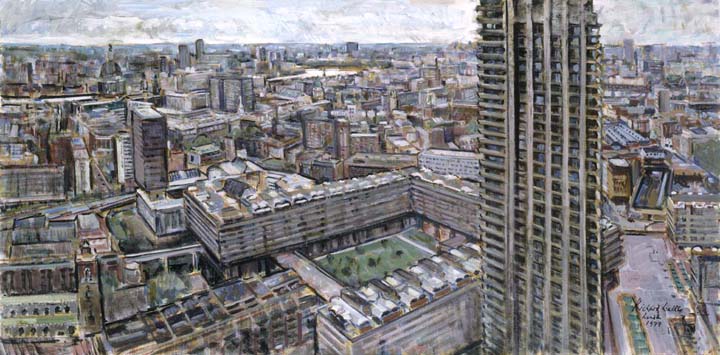
This painting is called Looking From Cromwell Tower and was painted by Richard I. B. Walker in 1977; the year after the new concrete estate had been completed. Its panoramic view of the City was taken from a ’small and rather precarious balcony’ on the top floor of Cromwell Tower. Apparently afraid of heights, Richard Walker strapped himself, his equipment and his ‘ominously-flapping canvas’ to the balcony in order to paint on the spot. The lower half of Walker’s oil painting shows the Barbican Estate. Shakespeare Tower is on the right, with the church of St Giles Cripplegate in the bottom left corner. Above the church tower to the right, Bastion House stands next to the Museum of London’s pitched glass roof. The Thames is visible beyond the dome of St Paul’s Cathedral. 

The painting shows that by the 1970’s most of the gaps in London landscape that had been caused by the War had been filled. The unrelenting and dull grey shapes of the painting (and in particular the overwhelming of St Paul’s Cathedral) call into question the merits of the new architecture. This is Cromwell Tower from which Walker painted his picture: 

2 comments

Bill Jacklin – London cityscapes

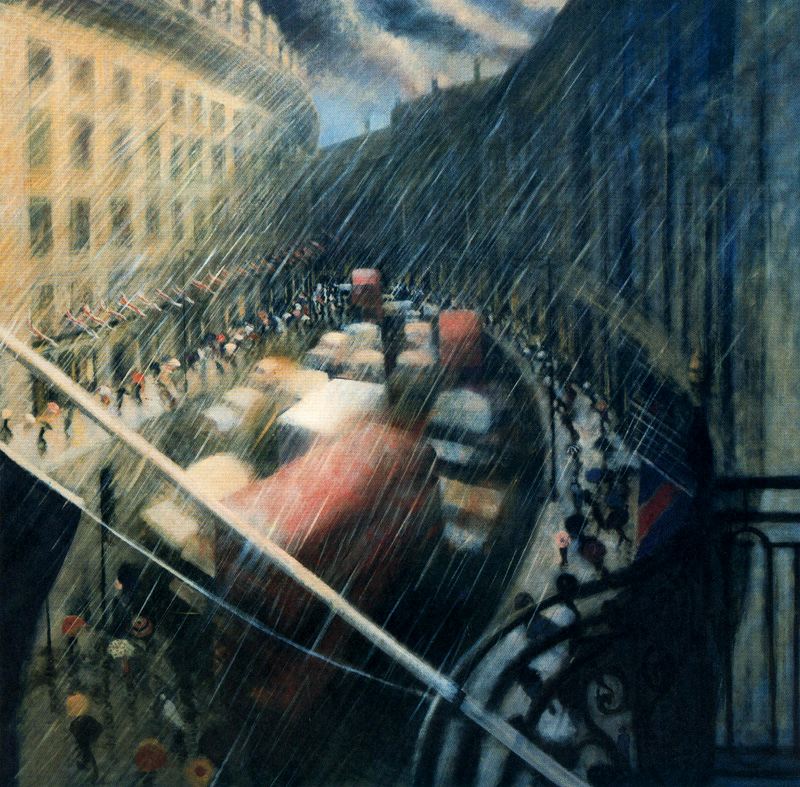
This is Before The Hurricane, Regent Street by Bill Jacklin, painted in 1988. I like the movement in this picture, the sweep of Regent Street and the lines of vehicles and pedestrians trailing along it with the rain cutting across all. The play of light on the buildings and vehicles is lovely.

Bill Jackson is a London born, London trained artist (Walthamstow School of Art, Royal College of Art in the 1960’s) who went on to teach at Chelsea School of Art and then the Royal College of Art through to the mid 1970’s. He’s worked in a variety of styles over the years but has returned time and again to cityscapes. Strangely, given where he was brought up and educated, the city in question for most of his works tends to be New York. He moved across to the Big Apple in 1985 and according to his website  has since concentrated on “painting ‘Urban Portraits’ of ‘the city’ in all its guises; from large scale canvases of crowds in flux to intimate moments in Seurat-like etchings”.

He has returned home to the Big Smoke from time to time to paint the odd London scene including the one of Regent Street which he worked up from this charcoal on paper piece called Regents Street In The Rain :

His returns to London have often been linked to large commissions such as the following two examples:

Futures Market, Royal Exchange, London which was painted in 1988

And this is The Ivy commissioned by the famous restaurant of the same name in 1992:

He was elected a Royal Academician in 1991.  Jacklin continues to live and works in New York.

There is an interesting interview with Jacklin by Jill Lloyd here.

Add a comment

Matthew Lindop’s clean-lined London pictures

Matthew Lindop paints cityscapes, mostly of London where he lives. This picture is The City At Night and is typical of his work. He spends his time looking up at the skyline and his subject tends to be the outline of the city’s buildings. People rarely make it into view. Its a very calm and collected world as a consequence.

He describes his approach on his website (here) : “Buildings are composed of defined lines, which is reflected in my work. I paint using flat colours and hard edges. I paint using household gloss paints, this gives the work a vibrant, polished, shiny and crisp appearance. I like to work on a large scale as I feel it increases the importance and stature of a painting.”

This next picture is Once Canda Square And HSBC. You can understand why a number of city companies have commissioned Matthew to paint pictures of the buildings that they occupy.

And sometimes he zooms in on a specific detail. This is Gherkin With Japanese Cherry Blossom which he painted as a commission for Trust magazine. I think the calm, clarity of James’ style works well with the Japanese theme.

You can also see Matthew’s work on Private View.

Add a comment

“Bishopsgate At Dusk” by Olha Pryymak


What a good picture. In it, London experiences one of those occasional and strange moments of calm. The traffic has been stopped at a junction, nobody is moving and a street suddenly and briefly empties. It’s as though the city itself has taken a deep breath and paused. 

The painting is set at dusk, a time of transition from day to night, and the picture is in part about this changing light. Natural daylight is draining out of the sky and giving in to the artificial bus headlights and red traffic lights which stand out brightly in the bottom, street level, half of the picture. Dusk is an unresolved and murky time of day, neither one thing nor the other, and we can feel vulnerable in it. The picture suggests that unsettling quality. The impatient cyclists who form a line in the foreground are literally waiting for the light to change (in their case from red to green, or at least, knowing London’s cyclists, from red to almost amber) before they can continue their race out of the city. But just for a small moment we can experience the fuggy eerie peace of the city at twilight, before the light does indeed inevitably change and the city re-erupts with its usual frenzy. 

Olha Pryymak is originally from the Ukraine but is now based in London. She paints and draws a lot of pictures of London street scenes, “documenting everything of my immediate environment…the choice of subject matter revolves around my own life in the city: my favorite places here are nooks and crannies of the East End and its various street markets” 

She has spent the last year aiming to paint a small 6×6 inch picture each day which include many London scenes. She sells them through Dailypainters, Etsy and her own site which also includes her blog. 

She had a good review (in The Daily Mirror of all places) of a piece she exhibited in the Royal Academy Summer Show in 2009. You can read it here.


1 comment