theLONDONi...theLONDONi...theLONDONi...theLONDONi...

small thoughts from the big city

Henry Moore – down in the tube station at midnight?

There’s a new exhibition of Henry Moore’s work at Tate Britain which runs from February 24th to August 8th, 2010.

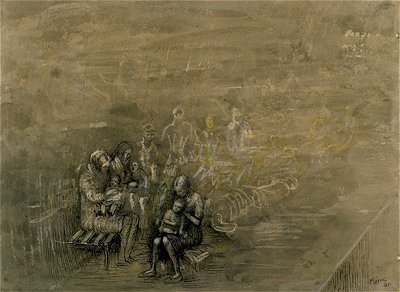
It includes some of the most famous pictures of London during the Second World War, including this one Women and Children in the Tube, which did much to cement Moore’s reputation as a globally significant artist.

Waldemar Januszczak looked at their origin in an article in The Sunday Times last weekend. In it he recalls the often told tale of how Moore claims to have come to create his London underground pictures after travelling home from a dinner party on the tube during the blitz:

“On the way home, the train stopped at every station. At each new platform, more and more frightened Londoners flocked into the tunnels to spend the night on the platforms: burying themselves in the dark to keep safe. Shocked, moved, inspired, Moore claimed he immediately began the great series of doomy underground scenes that were to endear him so fully to the British public and which seemed to put such a vivid face to a moment of national darkness.”

Look closely at the Moore picture above and particularly at the lady in the lower half of the painting in the middle. Then compare it to this photo of Caroline Wright and her son Harry shot by Bert Hardy for the Picture Post in 1940.

It looks clear that Moore copied this image – and Januszczak believes that further Picture Post pictures were the template for some of the other great Moore London Underground images. This undermines Moore’s claims to have created these works spontaneously in response to what he saw when travelling on the tube.

Although fascinating to pick over the bones of how stuff gets made, I’m not sure that any of this matters. I don’t think its very important where inspiration comes from; ultimately, all art lives and dies upon how that inspiration is channelled and the images that are created as a consequence. No doubt the story of how these pieces were conceived adds to their mythology – rather like how the story of Jack Kerouac having typed out On The Road in a few frenzied days on the back of rolls of wallpaper helped his myth making (in fact he’d been working on the book for years) – and so adds to their significance and saleability. The fact that the story may be part “tall tale” doesn’t detract from the power of the pictures. And hey, guess what…it’s got us all talking about Henry Moore again.

The full Sunday Time article is here

Add a comment

Under the weather: fog’s particular contribution to London art (and soup) in the late nineteenth century.

London exploded in size in the nineteenth century. In 1801 it had just over 1 million inhabitants. By 1901 the population had reached 6.5 million with the rate of growth accelerating as the century ran its course (a full 1 million was added to the population in the 1890’s alone, which is almost a 20% increase in just 10 years).

These new people required homes and coal fires to heat them. Many worked in London’s thriving heavy industry which was powered by vast coal burning engines. The smoke that spewed out of London homes and factories in the second half of the century was so great that it began reacting with the damp winter weather to produce thick shrouds of black fog that could envelop London for days and weeks. The worst occassion was from November 1879 to March 1880 when the fog was almost continuous and London was submerged in a strange dream world for five months. The fogs were dangerous for Londoners; hundreds died of asthma and other breathing difficulties caused by the condition. It certainly puts our recent week of snow and the chaos it caused into perspective. The gas street lights were left on all day and night and they lent the fog a yellow tinge. Locals called the condition a “London Particular” (Dickens uses the phrase in 1852/3’s Bleak House). A correspondent from the New York Times in 1871 described “a fog of the consistency of pea soup”. London responded by playfully renaming pea soup as “London Particular” – a rare example of soup imitating life. You can get the sainted Delia Smith’s recipe here. In 1905 the word “smog” was invented to describe the condition. And London became known as “The Big Smoke”

The swirling smogs changed distinctly how London looked and was experienced, of course. They hid secrets and made strange the familiar. This created an exciting new environment for art in general and the mysterious in particular.  Sherlock Holmes (who was written about by Conan Doyle between 1887 and 1927) exists in a London that is charcterised by confusion and fog. Holmes role is to cut through both to deduce what is really happening in the city. You can even see some smog in the CGI landscapes of the new Guy Ritchie Sherlock Holmes film. Robert Louis Stevenson’s Dr Jekyll and Mr Hyde occupy and explore the same landscape and here the fogs hide a multitude of sins. The popular image of Jack The Ripper is of a terrifying sadistic murderer stepping out of the mists to commit his atrocities before returning to the mists’ cloak of invisibility as a means of escaping into anonymity. It would seem that in the Ripper’s case the fog was not to blame, however, as none of the Ripper murders was committed on a foggy night. This has not stopped the film makers who use the fog as though it were the Ripper’s accomplice.

Artists of all varieties were inspired by the shape shifting qualities of the fog. The two most famous were James McNeill Whistler and Claude Monet who were both featured in a great Tate Britain exhibition on the subject back in 2005. You can still see the website here which locates many of the pictures geographically.

Whistler (who was an American artist based in London) painted a series of Nocturnes in the 1870’s showing London affected by fog.

Whistler's Nocturne: Blue and Gold - Old Battersea Bridge circa 1872-5

Whistler's Nocturne: The River at Battersea 1878

Claude Monet came over to London especially for the fog in 1899-1901, “I adore London…But what I love more than anything is the fog.” His remarkable pictures of London and particularly its waterfront and bridges capture some of what London must have been like at the peak of the smogs.

Monet's Charing Cross Bridge, Fog on the Thames 1899-1901

Monet's Houses of Parliament 1901

The fogs reduced in scale in the twentieth century before reappearing with vengeance in the 1950’s. This prompted the Clean Air Act of 1956 which saw them banished.

Add a comment