theLONDONi...theLONDONi...theLONDONi...theLONDONi...

small thoughts from the big city

Urban Sketchers – London

Urban Sketchers is a very simple concept. People from all over the world who can draw (and you have to passed as “good enough” to become a part of Urban Sketchers) sketch their surroundings, wherever they are, and then post their pictures up onto the Urban Sketchers website, tagging their images by subject, location and by artist. The artist often writes a few words about the sketch. The drawings have a simplicty and organic informality that is usually charming and relaxed. If photography is “fast food”, Urban Sketchers is firmly part of the “slow food” movvement. Not surprisingly London is one of the most featured and tagged places. Here are a few of the London images.  

This picture of St Paul’s Cathedral from the Tate Modern is by Rene Fijten from Holland.  You can find all of Rene Fijten’s Urban sketches here and his blog with more pictures here.

This simple snapshot of an unidentified London bridge is by Barry Jackson, whose website is here.

And this final one of our namesake the London Eye is by Adebanji Alade. His Urban sketches are here. His website is here.

The site is very unpretentious. It focuses on the drawings themslves and makes a real change from photography. A great site which is worth a regular visit to catch up on the progress and whereabouts of the artists.

Add a comment

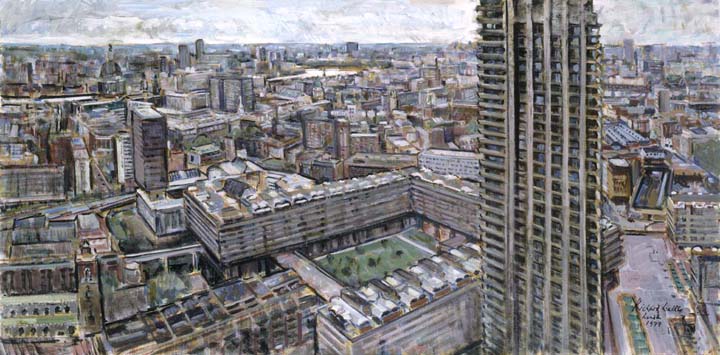
The Barbican’s concrete jungle, “Looking From Cromwell Tower”


The Cripplegate area of the City of London was decimated during the Blitz. In the 1950’s it was decided to build the Barbican residential estate on the Cripplegate ruins. It was designed by ubiquitous architects Chamberlin, Powell and Bon (who were to post-WWII London what Wren had been to the London recovering from The Great Fire), and built between 1965 and 1976 to provide homes to around 4,000 people living in over 2,000 flats. Flats were then thought to be the way forward; a very modern way of living. (David Kynaston’s Austerity Britain has a great section on the town planners’ post war move away from houses if you are interested). The estate was also designed to make maximum use of the (then) fashionable material, concrete. 

The Barbican estate was indeed intended as an experiment in modern urban living. It consists of 13 terrace blocks, grouped around a lake and green squares within the complex. The main buildings rise for up to seven floors above a podium level, which links all the facilities in the Barbican, providing a pedestrian route above street level. Some maisonettes are built into the podium structure. There’s no place for vehicles in the estate. It also contains three of London’s tallest residential towers, which are (from east to west); Cromwell Tower which was completed in 1973 (named after Oliver Cromwell), Shakespeare Tower (completed in 1976 – named after William Shakespeare) and Lauderdale Tower (completed in 1974 – named after the Earl of Lauderdale whose London house provided the site for this tower).  

This painting is called Looking From Cromwell Tower and was painted by Richard I. B. Walker in 1977; the year after the new concrete estate had been completed. Its panoramic view of the City was taken from a ’small and rather precarious balcony’ on the top floor of Cromwell Tower. Apparently afraid of heights, Richard Walker strapped himself, his equipment and his ‘ominously-flapping canvas’ to the balcony in order to paint on the spot. The lower half of Walker’s oil painting shows the Barbican Estate. Shakespeare Tower is on the right, with the church of St Giles Cripplegate in the bottom left corner. Above the church tower to the right, Bastion House stands next to the Museum of London’s pitched glass roof. The Thames is visible beyond the dome of St Paul’s Cathedral. 

The painting shows that by the 1970’s most of the gaps in London landscape that had been caused by the War had been filled. The unrelenting and dull grey shapes of the painting (and in particular the overwhelming of St Paul’s Cathedral) call into question the merits of the new architecture. This is Cromwell Tower from which Walker painted his picture: 

2 comments