theLONDONi...theLONDONi...theLONDONi...theLONDONi...

small thoughts from the big city

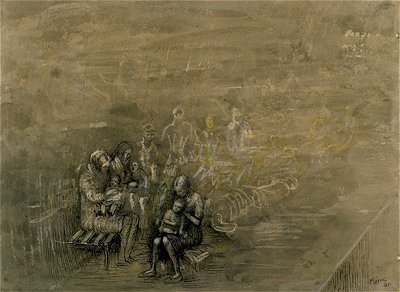
Henry Moore – down in the tube station at midnight?

There’s a new exhibition of Henry Moore’s work at Tate Britain which runs from February 24th to August 8th, 2010.

It includes some of the most famous pictures of London during the Second World War, including this one Women and Children in the Tube, which did much to cement Moore’s reputation as a globally significant artist.

Waldemar Januszczak looked at their origin in an article in The Sunday Times last weekend. In it he recalls the often told tale of how Moore claims to have come to create his London underground pictures after travelling home from a dinner party on the tube during the blitz:

“On the way home, the train stopped at every station. At each new platform, more and more frightened Londoners flocked into the tunnels to spend the night on the platforms: burying themselves in the dark to keep safe. Shocked, moved, inspired, Moore claimed he immediately began the great series of doomy underground scenes that were to endear him so fully to the British public and which seemed to put such a vivid face to a moment of national darkness.”

Look closely at the Moore picture above and particularly at the lady in the lower half of the painting in the middle. Then compare it to this photo of Caroline Wright and her son Harry shot by Bert Hardy for the Picture Post in 1940.

It looks clear that Moore copied this image – and Januszczak believes that further Picture Post pictures were the template for some of the other great Moore London Underground images. This undermines Moore’s claims to have created these works spontaneously in response to what he saw when travelling on the tube.

Although fascinating to pick over the bones of how stuff gets made, I’m not sure that any of this matters. I don’t think its very important where inspiration comes from; ultimately, all art lives and dies upon how that inspiration is channelled and the images that are created as a consequence. No doubt the story of how these pieces were conceived adds to their mythology – rather like how the story of Jack Kerouac having typed out On The Road in a few frenzied days on the back of rolls of wallpaper helped his myth making (in fact he’d been working on the book for years) – and so adds to their significance and saleability. The fact that the story may be part “tall tale” doesn’t detract from the power of the pictures. And hey, guess what…it’s got us all talking about Henry Moore again.

The full Sunday Time article is here

Add a comment

Cyril E Power – going down the tube between the wars and a visit to ‘Appy ‘Ampstead

What a cracking image! Sleek and modernistic. Very 1930’s. 

It’s called Whence and Whither – a great title to boot! – and was produced by Cyril E, for Edward, Power in 1930. (He had a son called Cyril A, for Arthur, Power hence the need for the middle name letter).

Cyril Power, born in Chelsea in London in 1872, was a architect who followed in his father’s footsteps career-wise. He had a succesful business as a practicing architect and he also lectured on the subject at University College, London and later at Goldsmith’s College down in New Cross. In his “other” life, he was a compulsive artist who worked in many styles including ink and pen, illustrations and oils.

In the late 1920’s, Power began using linocuts. This was, at the time, a new and cheap artistic process that had been developed in Germany before the Great War and was being experimented with across Europe. Fellow London artists, Claude Flight and Sybil Andrews (with whom he shared a studio) created a mini-school of London Linocutters and showed their work at a series of exhibitions in the Redfern Gallery, the first one in 1929.

He produced several of pictures of scenes from the london underground between 1929 and 1934. Ironically (and in an opposite trajectory to the typical “London” artist) he moved his family out of London during this period and so made these images as an exiled Londoner looking into the city from the outside. I think that they are lovely.

I’ve arranged the pictures as if they illustrated a trip on the tube to the fair on Hampstead Heath (although they weren’t painted in this order):

This is a close up of The Escalator (1930)  

And this one on The Tube Station (1925) itself

And then onto The Tube Train (1934)

Arriving in ‘Appy A’mpstead (1933)

In the late nineteenth and early twentieth century Hampstead Heath was the in place to go on Bank Holiday weekends. There was a funfair and tens of thousands congregated to enjoy an ‘Appy ‘Ampstead. You can see some excellent Pathe film of the 1931 event, here. Power’s inspiration is plain to see. Other artists drew upon the subject of this funfair, including Arthur Rackham in 1913, here, and various musicians including Albert Ketelby who composed Bank Holiday (‘Appy ‘Ampstead) as part of his Cockney Suite in 1924. Nothing goes together quite like Funfairs and cheap pop music, and there was inevitably a big music hall hit in the 1890’s to sing praise to the phenomenon and publicise the phrase ‘Appy ‘Ampstead, written by Albert Chevalier.

In a moment of serendipity, I’ve discovered (just this second!) that my favourite website of, and about, London songs The London Nobody Sings has covered this exact subject recently. Rather than re-invent the wheel, I suggest you go and read their piece on The ‘Ampstead Way. And you can see my previous blog on he wonders of The London Nobody Sings, here. Like the funfair, its always worth a visit!

My favourite ride at the funfair is The Merry Go Round (1929) and this is my favourite, and final, of these pictures by Power because of the feeling of exhilarating movement:

Cyril Power moved on to work in other styles but I think these linocuts were a great period of his work. He returned to London in later life and died in 1951. 

2 comments

The brass bands play and the feet start to pound…we’re going underground.

This picture made me smile.

Balham tube station changes line....

Balham tube is on the common or garden and perhaps a smidge grotty Northern line. Computer malfunction or more likely post-New Year (hung over?) operator error appears to have relocated it temporarily onto the far posher and recently lavishly developed Jubilee line. I think its fair to say that Balham has come up in the world in recent times (hey, I live there!!) and probably has further “aspirations” but changing tube lines is surely beyond even this Hyacinth Bouquet of neighbourhoods.

My simple pleasure at this simple error is made greater by the fact that I discovered it on london-underground “Going Underground” blog . If you have any tube type itch that needs scratching this is the place to head to. It has a mole-like nature, happiest when deep below the London streets and only occassionally and reluctantly coming above ground, blinking in the daylight. It’s clearly the work of a slight obsessive, but it’s also amused by, and amusing about, all things underground and so comfortably transcends the nerdy. Time Out made london-underground one London’s Top 50 websites. I’d put it well towards the top of that list. It has a great and unusual persective on the city.

1 comment