theLONDONi...theLONDONi...theLONDONi...theLONDONi...

small thoughts from the big city

Great photographs of London

I found these pictures on Flickr. They were taken by Katarina 2353 (real name Katarina Stefanović) and are stunning. I’ve tried to get in touch with her to send her a note of appreciation, but have had no luck. 

No doubt Katarina has used photshop, but she has used it well. You can see all of Katarina’s London photos here.

She also has created some wonderful countryside landscapes which have been highlighted in this Living Design blog.

Add a comment

Patrick Keiller’s London. Then & Now.

Patrick Keiller made his strange, uncategorisable  film, London, in 1992. It’s not a documentary although it uses documentary style footage and it’s certainly not traditional fiction. Perhaps Peter Ackroyd’s towering London: The Biography sits closest to it with an impressionistic mix of factual grit and poetic fancy suggesting the capital.

The film is narrated by an unnamed character (voiced by Paul Scofield) who follows his friend, the unseen Robinson around London. Robinson is apparently involved with research into the “problem of London”. The film was made 13 years into a long period of Tory rule (from 1979 and 1997) and Keiller is clearly not a card carrying Conservative. The narrator records a city that is being badly let down and wearied by Thatcherism and its successors.

Here is an example from the film.


You can watch the full film here.

James Bridle has taken on the task of recreating the 1992 film scene by scene by filming the same shots as Keiller used in the original. Its now 13 years since Labour came to power and London has been reshaped in the intervening years. It feels an appropriate time to be comparing how London was with how London is.

James is writing about his progress on this website, shortermemoryloss.com.

Add a comment

Bill Jacklin – London cityscapes

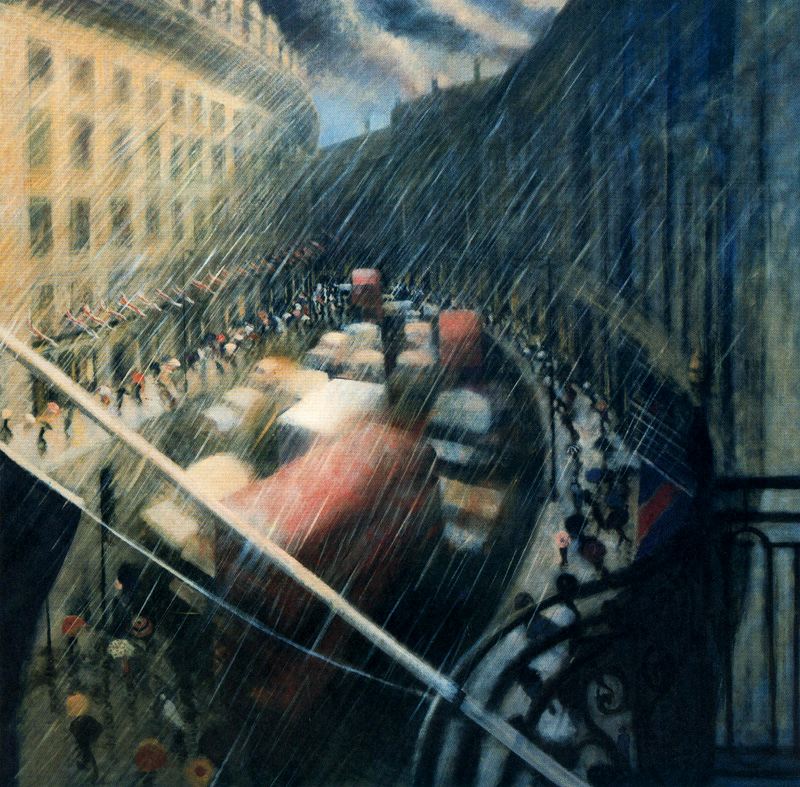
This is Before The Hurricane, Regent Street by Bill Jacklin, painted in 1988. I like the movement in this picture, the sweep of Regent Street and the lines of vehicles and pedestrians trailing along it with the rain cutting across all. The play of light on the buildings and vehicles is lovely.

Bill Jackson is a London born, London trained artist (Walthamstow School of Art, Royal College of Art in the 1960’s) who went on to teach at Chelsea School of Art and then the Royal College of Art through to the mid 1970’s. He’s worked in a variety of styles over the years but has returned time and again to cityscapes. Strangely, given where he was brought up and educated, the city in question for most of his works tends to be New York. He moved across to the Big Apple in 1985 and according to his website  has since concentrated on “painting ‘Urban Portraits’ of ‘the city’ in all its guises; from large scale canvases of crowds in flux to intimate moments in Seurat-like etchings”.

He has returned home to the Big Smoke from time to time to paint the odd London scene including the one of Regent Street which he worked up from this charcoal on paper piece called Regents Street In The Rain :

His returns to London have often been linked to large commissions such as the following two examples:

Futures Market, Royal Exchange, London which was painted in 1988

And this is The Ivy commissioned by the famous restaurant of the same name in 1992:

He was elected a Royal Academician in 1991.  Jacklin continues to live and works in New York.

There is an interesting interview with Jacklin by Jill Lloyd here.

Add a comment

I left the North, I travelled South…and I can’t help the way that I feel.

 Morrissey was the lead singer with The Smiths. They were a tremendously Northern, as in North of England, band their faces set stern against the soft South and suspicious of London in particular. And like many a self-consciously Northern band before and since, they moved to the big bad southern city as soon as was humanly possible.

 Mozza (as Morrissey is known) has had a complicated relationship with the city (Oh! the yearning, Oh! the dread…). To be fair to London, Morrissey has had complicated relationships with most of the world. He first tried to live in London aged 17, befor ehe formed the band. “I brought everything I possessed in these two huge cases”, he recalls. He lasted days before retreating back “oop North”, tail between legs. “It was a really awful experience”. Later, in early Smiths interviews, he described London as a dreadful “impersonal place”.

But London has usually been ”where it’s at” in the music business and was certainly so in the 1980’s. The Smiths broke big in 1984 and Morrissey and his song-writing partner & the guitarist Johnny Marr were both (separately) ensconced in the city by the year end. London’s allure proved too much for Morrissey’s doubts. One of their songs called, appropriately enough, London describes a young man heading down to London as his friends, (soon to be ex) girlfriend and family gather on a Northern railway station to bid farewell, nerves and uncertainty affect the young man “but did you see the jealousy in the eyes of the ones you left behind?” That old devil, London.

Here is the song with an effective video of edited clips from Billy Liar (one of Mozza’s favourite films) to illustrate:

During the 1980’s Morrissey moved around London renting houses convenient for his habit of retracing the steps of his pantheon of heroes such as Oscar Wilde.

The Smith split up in 1987 and Morrissey dropped anchor in London buying a house in Regents Park Terrace on the edges of Camden Town and Primrose Hill. It was a house with a history; its interior had been designed by William Haines a former silent movie star whose career was cut short due to controversy over his homosexuality and previous occupants included silent movie meg-star Tallulah Bankhead and, more recently, Jasper Conran the fashion designer. Morrissey became friends with the writer Alan Bennett another Northerner in exile who lived in the next road and often went for tea.

Morrissey was regularly seen in Camden supping pints of lager in the music pubs of the area up to the mid -1990’s. “I regret to say [London] really is as exciting as some people who are always considered to be misguided say it is. I think when you visit London and you only stay for a few days you get a completely obscure vision of the place and it seems impersonal and hateful and synthetic. But when you stay here for a long time you realise the enormous advantages….In Manchester the entire place closes at 8pm …but here you can go wherever you want to, whenever you want to and do whatever you want to.”

Morrissey’s early solo songs reflect this infatuation with the city. His London is mythological, composed of Union Jack tattooed skinheads (Your Arsenal album) , dark horror-filled Commons (Mute Witness) rent boys talking Polari on the meat rack at Piccadilly Circus (Piccadilly Palare), the lost (Half A Person), gangsters (Last of the International Playboys), East End boxers (Boxers), Jack The Ripper and ageing Soho Lotharios (Trouble Loves Me). It’s a London that even at the time was old-fashioned and backward looking.

And then of course, Morrissey fell out of love. Ever the contrarian he upped sticks and moved to LA. In Glamorous Glue he sang “We look to Los Angeles for the language we use. London is dead.” And he chose the future over the London past. He’s still there (mostly). He has been living in a hotel just off Sunset Boulevard. But it will never be entirely over for Morrissey and London. In Come Back To Camden he sings a love song to London, with its “slate grey Victorian skies”, “taxi drivers that never stop talking” and “tea with the taste of the Thames”. It’s one of the great London songs:


Add a comment

Disney re-draws London

I’ve just come across this superb analysis of Disney’s original animated version of 101 Dalmations. Its written by Oswald Iten in his Colourful Animation Expressions blog. Oswald explores the way in which London is used symbolically in the film. It’s worth a read and makes some interesting points about what is going on in the movie and the way in which the story is being told.

I’ve always liked the animated version of 101 Dalmations (alternatively I loathe the recent re-makes) and the way in which it was drawn. Unusually for a Disney film, one man was largely resposible for the entire storyboard. His name was Bill Peet, he sadly passed away in 2002, and he was also an illustrator of note. His website is here. Peet made London look twee but lovely. I have one small bone to pick as, apart from the obvious landmarks of Big Ben etc, the London that Peet and his team drew looks nothing much like the London I know. In fact it looks more like Paris to me. Anybody got any ideas where these streets are meant to be in London? Its never detracted from my enjoyment of the film and I’m always prepared to grant artistic licence, but its a slight nagging distraction.

1 comment

Under the weather: fog’s particular contribution to London art (and soup) in the late nineteenth century.

London exploded in size in the nineteenth century. In 1801 it had just over 1 million inhabitants. By 1901 the population had reached 6.5 million with the rate of growth accelerating as the century ran its course (a full 1 million was added to the population in the 1890’s alone, which is almost a 20% increase in just 10 years).

These new people required homes and coal fires to heat them. Many worked in London’s thriving heavy industry which was powered by vast coal burning engines. The smoke that spewed out of London homes and factories in the second half of the century was so great that it began reacting with the damp winter weather to produce thick shrouds of black fog that could envelop London for days and weeks. The worst occassion was from November 1879 to March 1880 when the fog was almost continuous and London was submerged in a strange dream world for five months. The fogs were dangerous for Londoners; hundreds died of asthma and other breathing difficulties caused by the condition. It certainly puts our recent week of snow and the chaos it caused into perspective. The gas street lights were left on all day and night and they lent the fog a yellow tinge. Locals called the condition a “London Particular” (Dickens uses the phrase in 1852/3’s Bleak House). A correspondent from the New York Times in 1871 described “a fog of the consistency of pea soup”. London responded by playfully renaming pea soup as “London Particular” – a rare example of soup imitating life. You can get the sainted Delia Smith’s recipe here. In 1905 the word “smog” was invented to describe the condition. And London became known as “The Big Smoke”

The swirling smogs changed distinctly how London looked and was experienced, of course. They hid secrets and made strange the familiar. This created an exciting new environment for art in general and the mysterious in particular.  Sherlock Holmes (who was written about by Conan Doyle between 1887 and 1927) exists in a London that is charcterised by confusion and fog. Holmes role is to cut through both to deduce what is really happening in the city. You can even see some smog in the CGI landscapes of the new Guy Ritchie Sherlock Holmes film. Robert Louis Stevenson’s Dr Jekyll and Mr Hyde occupy and explore the same landscape and here the fogs hide a multitude of sins. The popular image of Jack The Ripper is of a terrifying sadistic murderer stepping out of the mists to commit his atrocities before returning to the mists’ cloak of invisibility as a means of escaping into anonymity. It would seem that in the Ripper’s case the fog was not to blame, however, as none of the Ripper murders was committed on a foggy night. This has not stopped the film makers who use the fog as though it were the Ripper’s accomplice.

Artists of all varieties were inspired by the shape shifting qualities of the fog. The two most famous were James McNeill Whistler and Claude Monet who were both featured in a great Tate Britain exhibition on the subject back in 2005. You can still see the website here which locates many of the pictures geographically.

Whistler (who was an American artist based in London) painted a series of Nocturnes in the 1870’s showing London affected by fog.

Whistler's Nocturne: Blue and Gold - Old Battersea Bridge circa 1872-5

Whistler's Nocturne: The River at Battersea 1878

Claude Monet came over to London especially for the fog in 1899-1901, “I adore London…But what I love more than anything is the fog.” His remarkable pictures of London and particularly its waterfront and bridges capture some of what London must have been like at the peak of the smogs.

Monet's Charing Cross Bridge, Fog on the Thames 1899-1901

Monet's Houses of Parliament 1901

The fogs reduced in scale in the twentieth century before reappearing with vengeance in the 1950’s. This prompted the Clean Air Act of 1956 which saw them banished.

Add a comment

Great London images by James Hobbs

Paddington by James Hobbs

Spitalfields by James Hobbs

James Hobbs is a freelance illustrator who lives and works in London. You can find out more about him on his website, here.

I like his pictures. They are, as you can see, very nice to look at. The images are clean and easy on the eye but their simplicity is deceptive and the more I look at them, the more I notice things going on. I also like this snippet that shows James’s approach to his work:

“When it comes to drawing, though, I am often taken by the more mundane things going on. I like to stand before the great city sights, remove the workbook from the bag, uncap the marker, and then turn around before starting to draw. It’s the street furniture, the everyday, the ubiquitous stuff that is easily overlooked that makes a city what it really is. It’s a kind of anti-celebrity view of the world that I like. They creep in, of course: the Post Office Tower, Canary Wharf or the Gherkin crane their necks to get a look in, but I try, at least, to keep them in their place.”

He can do simplicity as well. Possibly my favourite picture is this one called Obama day from when the US President visited London. Its just a fly-like helicopter above a slice of the London Eye. When I look at it I can hear the blades rotating and imagine the hurly burly of the motorcade that is happening off-stage. The picture captures a point of calm at the centre of a wheel of frenzied activity. Its reminds me of a Japanese Haiku poem. 

Obama Day by James Hobbs

 Oh, and whatever he says, he can indeed do “celebrity” London buildings as well as this waterscape proves.

Waterloo Bridge by James Hobbs

These are wonderful London images and James sells them and takes commissions here. If anybody is looking for ideas for presents for my next birthday I would love one of them……..

Add a comment

What does London look like on the first day back after the Christmas holidays?

Twitter gives you a great perspective. Here are some examples of how some London people that I follow are feeling about the world this morning….

Still cant get to sleep—->

2.42am India Knight : “This is a disaster. It’s end-of-Christmas Monday and I’m awake and it’s 2.41.”

Working through the night—-> 

4.30am: Tom Reynolds  who is an ambulance driver and working nights :”Second job tonight where we have a not very sick person, and the ambulance has been followed by a relative in a car.”

Back to work/school anxiety—–>

4.46am: Polstar who is a teacher:”nightmares all last night about starting teaching tomorrow – not good :( “   I know that feeling.

Back to normal—–>

5.49am: Iain Dale  political commentator: “Will be on GMTV at 6.10am with @jessica_asato talking about the state of politics.”

Back with a bong—->

6am: Big Ben : “BONG BONG BONG BONG BONG BONG” Always a reliable twitterer!

Back with a bang—->

6.24am KristainLondon: “Trying to start 2010 off right…got up at 5:45 so I can be in the office by 7 and clear out my 800 unread emails.”

Back to work transport nightmare—->

6.50am BBCTravelAlert: “good morning – happy new ones and what a start to the day- my car is frozen solid. Jules here. Brrrr-cats out there & probs on public tranny”  

7am: BritJamez: “It was soooooo cold when I woke at 5 this morning!!! It’s not THAT much warmer now!”

7.45am. Simon Collister : “Queue this morning out of ticket office, across main concourse, through WH Smi’ths and right up to coffee counter next door. #backtoworkfail

7.53am. BBCTravelAlert: “District Line spended tween Wimbledon & Parsons Green & H’mith And Cit tween Whitechapel & Barking due sig failure.The Drain spended too”

8.06am. Simon Collister : “My glasses have frozen to my face”

A day for working at home perhaps—->

8.10am. Lucy Inglis : “Slippers check, dressing gown check, kettle on check, cricket on check, duvet carefully arranged on sofa check. Combine.”

8.10am. DarrelButcher: “Now that’s more like it. up and dressed, mummy off to work and household jobs on the go, welcome back everyone……”

8.14am. Dave Hill : “Samuel Pepys’s diaries began 350 years ago http://bit.ly/751OD0

And so (with that) back to bed I think……………the cricket’s started. And unbelievably England have taken 4 wickets for 17 runs; South africa all out. This must be a sign!

1 comment