theLONDONi...theLONDONi...theLONDONi...theLONDONi...

small thoughts from the big city

The Borribles – pointy eared class warfare in South London

 A couple of months ago Londonist website ran a poll to choose the best London novel of all time.  I’d heard of most of the top ten and had even read a few of them, but I was taken by surprise by the winner. The Borribles? Never heard of it/them. The author, Michael de Larrabeiti, was also unknown to me. It turned out that a bunch of Borribalista’s had rigged the vote and coerced the book to the top of the Londonist chart. I made a mental note to investigate further. A first quick look on the web and I could see they were books aimed at early to mid teenagers, written in the 1970’s and reasonably well reviewed. It turned out that they were partly set in my South London neighbourhood. I asked at my local bookshop but the shop assistant had not heard of the books and couldn’t find them in their ordering system. Similarly my local library’s children’s section drew a blank. The very nice local librarian had neither heard of the books nor could find them anywhere in the library records. I tracked the book down on the internet (of course) and ordered myself a copy. And…..well, I simply can’t work out why this series of books is not huge.

The Borribles are strange feral youths that exist in and are loyal to the old working class neighbourhoods of central(ish) London including Battersea, Wandsworth, Hoxton and Hackney in which they live. Borribles aren’t born but are made. They start out as normal children but turn into Borribles after a “bad start” in life leads to them becoming “unmanageable” in normal society. So they exist in the margins of life, squatting in the derelict buildings that were still plentiful in the 1970’s, stealing from street markets to feed themsleves and living in tribal and fiercely territorial gangs. Over time the kids sprout pointed ears – the key charcteristic of a Borrible – and whilst their ears are pointed they never grow up. If that sounds a bit twee and Peter Pan-like, their foul language and tendency to take on and kill their enemies, including the police, with steel catapults marks them down as more like characters out of a Richard Allen book such as Skinhead or Suedehead. Certainly the Borribles occupy the same sort of harsh unsentimental London that those skinheads did. If the police get hold of them they clip the Borribles’ ears ( a clip round the earhole!) and that turns them back into children who proceed to age and fade into adulthood.

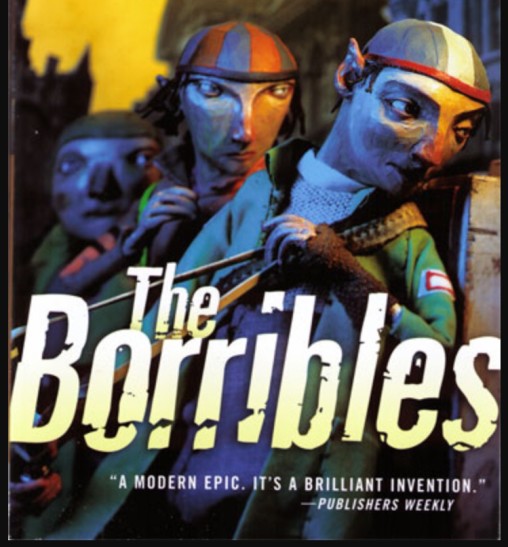
De Larrabeiti wrote three Borribles adventures which achieved some critical success in the UK, US and in Germany (see the sleeve above). The first of the books was published in 1976 and describes a London that feels very different to how it is now. People have less. Anger is in the air. Punk rock is not a million miles away. Sinister rag and bone men still ride round on horses and carts. Battersea is a rough and ready neighbourhood. The first book opens with the Borribles under attack from strange creatures called the Rumbles of Rumbledon who are plummy voiced representations of the dreadful middle class intent on gentrifying the Borribles beloved Battersea and then pushing further into working class London. The Borribles respond by sending an elite task force to the home of the Rumbles to cause critical and brutal damage to their adversaries. The first book is the story of that adventure.

You might have guessed that the Rumbles are a thinly veiled reference to the Wombles of Wimbledon Common. The Rumbles can’t pronounce their “r’s” properly; they come out as “w’s”, hence Rumble sounds like Wumble; Rumbledon becomes Wumbledon. Whereas Borribles are rough and ready, Rumbles are posh and arrogant and talk using old fashioned phrases like “old bean” and “spiffing”. Clearly De Larrabeiti took extreme offense at the Wombles – and the middle classes that they represent – because the violence that he has  The Borribles inflict upon the poor Rumbles is truly blood-curdling.

I loved the books because their stories take place on the streets where I now live and I can recognise some of the pubs and churches. Even a shop or two remain from those days. The overall nature of the area however has changed beyond compare. Contrary to what happens in the books however, in truth it is the Rumbles (& not the Borribles) who won because most of the formerly working-class “cockney” areas that are described are now full of private prep schools, 4×4’s driven by yummy mummies and Starbucks coffe shops. What is interesting is how these books strip back that veneer of gentrification to show how the areas used to be and suggest something of their essential nature.

I was genuinely astonished out how bloody and exciting the tales were. The set piece battles are gory and the morality of the characters is harsh and pays no lip service to political correctness. These stories feel as though they are taking place in a real and uncompromising world despite the conceits of the Rumbles, who are like huge rats that walk on hind legs, and the Borribles’ ears. In this mix of fantasy and reality they share something with the books of Philip Pullman. I suspect Pullman has read and digested them. The Gobblers of His Dark Materials are related to the Borrible abductors Dewdrop and Ernie.


Although the first book in the trilogy received critical success it did not sell in huge quantities and from my limited research has been largely forgotten, at least in the locality in which it was created. It may well be because of the violent subject matter.  This first book was followed by two more: The Borribles Go for Broke (1981) and Across the Dark Metropolis (1986). Both books refused to tone down their contents and their continuing anti-police message jarred with the mainstream world of children’s books and were particularly out of step following the riots in Brixton and Tottenham. De Larrabeiti struggled to find a publisher for the third book after Collins, the original publisher withdrew from publication at the last moment. He never wrote about the Borribles again.

You can follow people purporting to be The Borribles on twitter. How very modern….

1 comment

Under the weather: fog’s particular contribution to London art (and soup) in the late nineteenth century.

London exploded in size in the nineteenth century. In 1801 it had just over 1 million inhabitants. By 1901 the population had reached 6.5 million with the rate of growth accelerating as the century ran its course (a full 1 million was added to the population in the 1890’s alone, which is almost a 20% increase in just 10 years).

These new people required homes and coal fires to heat them. Many worked in London’s thriving heavy industry which was powered by vast coal burning engines. The smoke that spewed out of London homes and factories in the second half of the century was so great that it began reacting with the damp winter weather to produce thick shrouds of black fog that could envelop London for days and weeks. The worst occassion was from November 1879 to March 1880 when the fog was almost continuous and London was submerged in a strange dream world for five months. The fogs were dangerous for Londoners; hundreds died of asthma and other breathing difficulties caused by the condition. It certainly puts our recent week of snow and the chaos it caused into perspective. The gas street lights were left on all day and night and they lent the fog a yellow tinge. Locals called the condition a “London Particular” (Dickens uses the phrase in 1852/3’s Bleak House). A correspondent from the New York Times in 1871 described “a fog of the consistency of pea soup”. London responded by playfully renaming pea soup as “London Particular” – a rare example of soup imitating life. You can get the sainted Delia Smith’s recipe here. In 1905 the word “smog” was invented to describe the condition. And London became known as “The Big Smoke”

The swirling smogs changed distinctly how London looked and was experienced, of course. They hid secrets and made strange the familiar. This created an exciting new environment for art in general and the mysterious in particular.  Sherlock Holmes (who was written about by Conan Doyle between 1887 and 1927) exists in a London that is charcterised by confusion and fog. Holmes role is to cut through both to deduce what is really happening in the city. You can even see some smog in the CGI landscapes of the new Guy Ritchie Sherlock Holmes film. Robert Louis Stevenson’s Dr Jekyll and Mr Hyde occupy and explore the same landscape and here the fogs hide a multitude of sins. The popular image of Jack The Ripper is of a terrifying sadistic murderer stepping out of the mists to commit his atrocities before returning to the mists’ cloak of invisibility as a means of escaping into anonymity. It would seem that in the Ripper’s case the fog was not to blame, however, as none of the Ripper murders was committed on a foggy night. This has not stopped the film makers who use the fog as though it were the Ripper’s accomplice.

Artists of all varieties were inspired by the shape shifting qualities of the fog. The two most famous were James McNeill Whistler and Claude Monet who were both featured in a great Tate Britain exhibition on the subject back in 2005. You can still see the website here which locates many of the pictures geographically.

Whistler (who was an American artist based in London) painted a series of Nocturnes in the 1870’s showing London affected by fog.

Whistler's Nocturne: Blue and Gold - Old Battersea Bridge circa 1872-5

Whistler's Nocturne: The River at Battersea 1878

Claude Monet came over to London especially for the fog in 1899-1901, “I adore London…But what I love more than anything is the fog.” His remarkable pictures of London and particularly its waterfront and bridges capture some of what London must have been like at the peak of the smogs.

Monet's Charing Cross Bridge, Fog on the Thames 1899-1901

Monet's Houses of Parliament 1901

The fogs reduced in scale in the twentieth century before reappearing with vengeance in the 1950’s. This prompted the Clean Air Act of 1956 which saw them banished.

Add a comment