We love this city. Its way too big for one person to understand completely. We are interested in how London is seen, experienced and portrayed by people in real life and in the arts.
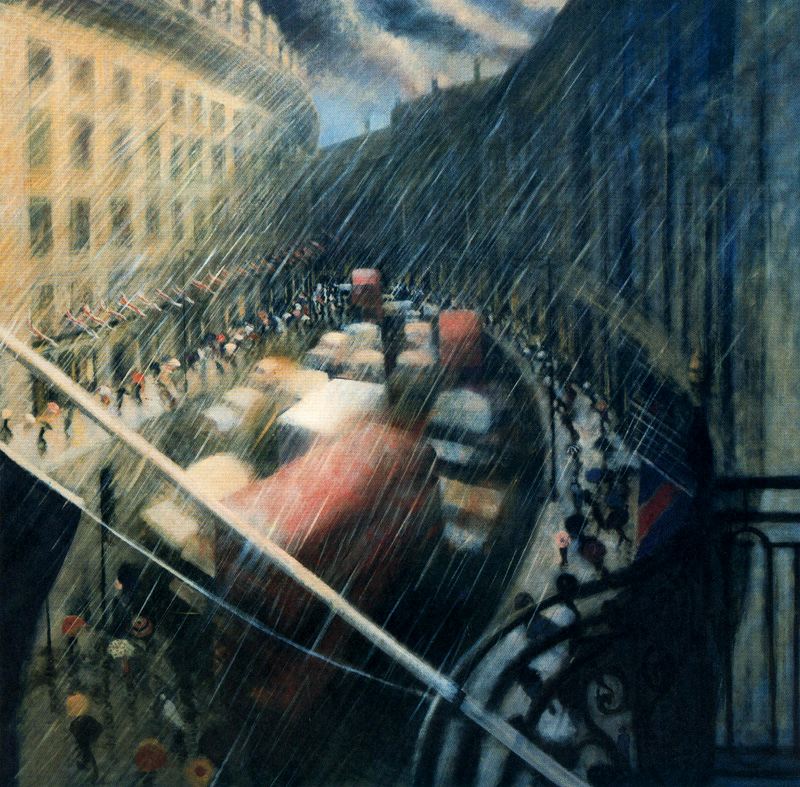
This is Before The Hurricane, Regent Street by Bill Jacklin, painted in 1988. I like the movement in this picture, the sweep of Regent Street and the lines of vehicles and pedestrians trailing along it with the rain cutting across all. The play of light on the buildings and vehicles is lovely.
Bill Jackson is a London born, London trained artist (Walthamstow School of Art, Royal College of Art in the 1960’s) who went on to teach at Chelsea School of Art and then the Royal College of Art through to the mid 1970’s. He’s worked in a variety of styles over the years but has returned time and again to cityscapes. Strangely, given where he was brought up and educated, the city in question for most of his works tends to be New York. He moved across to the Big Apple in 1985 and according to his website has since concentrated on “painting ‘Urban Portraits’ of ‘the city’ in all its guises; from large scale canvases of crowds in flux to intimate moments in Seurat-like etchings”.
He has returned home to the Big Smoke from time to time to paint the odd London scene including the one of Regent Street which he worked up from this charcoal on paper piece called Regents Street In The Rain :
His returns to London have often been linked to large commissions such as the following two examples:
Futures Market, Royal Exchange, London which was painted in 1988
And this is The Ivy commissioned by the famous restaurant of the same name in 1992:
Morrissey was the lead singer with The Smiths. They were a tremendously Northern, as in North of England, band their faces set stern against the soft South and suspicious of London in particular. And like many a self-consciously Northern band before and since, they moved to the big bad southern city as soon as was humanly possible.
Mozza (as Morrissey is known) has had a complicated relationship with the city (Oh! the yearning, Oh! the dread…). To be fair to London, Morrissey has had complicated relationships with most of the world. He first tried to live in London aged 17, befor ehe formed the band. “I brought everything I possessed in these two huge cases”, he recalls. He lasted days before retreating back “oop North”, tail between legs. “It was a really awful experience”. Later, in early Smiths interviews, he described London as a dreadful “impersonal place”.
But London has usually been ”where it’s at” in the music business and was certainly so in the 1980’s. The Smiths broke big in 1984 and Morrissey and his song-writing partner & the guitarist Johnny Marr were both (separately) ensconced in the city by the year end. London’s allure proved too much for Morrissey’s doubts. One of their songs called, appropriately enough, London describes a young man heading down to London as his friends, (soon to be ex) girlfriend and family gather on a Northern railway station to bid farewell, nerves and uncertainty affect the young man “but did you see the jealousy in the eyes of the ones you left behind?” That old devil, London.
Here is the song with an effective video of edited clips from Billy Liar (one of Mozza’s favourite films) to illustrate:
During the 1980’s Morrissey moved around London renting houses convenient for his habit of retracing the steps of his pantheon of heroes such as Oscar Wilde.
The Smith split up in 1987 and Morrissey dropped anchor in London buying a house in Regents Park Terrace on the edges of Camden Town and Primrose Hill. It was a house with a history; its interior had been designed by William Haines a former silent movie star whose career was cut short due to controversy over his homosexuality and previous occupants included silent movie meg-star Tallulah Bankhead and, more recently, Jasper Conran the fashion designer. Morrissey became friends with the writer Alan Bennett another Northerner in exile who lived in the next road and often went for tea.
Morrissey was regularly seen in Camden supping pints of lager in the music pubs of the area up to the mid -1990’s. “I regret to say [London] really is as exciting as some people who are always considered to be misguided say it is. I think when you visit London and you only stay for a few days you get a completely obscure vision of the place and it seems impersonal and hateful and synthetic. But when you stay here for a long time you realise the enormous advantages….In Manchester the entire place closes at 8pm …but here you can go wherever you want to, whenever you want to and do whatever you want to.”
Morrissey’s early solo songs reflect this infatuation with the city. His London is mythological, composed of Union Jack tattooed skinheads (Your Arsenal album) , dark horror-filled Commons (Mute Witness) rent boys talking Polari on the meat rack at Piccadilly Circus (Piccadilly Palare), the lost (Half A Person), gangsters (Last of the InternationalPlayboys), East End boxers (Boxers), Jack The Ripper and ageing Soho Lotharios (Trouble Loves Me). It’s a London that even at the time was old-fashioned and backward looking.
And then of course, Morrissey fell out of love. Ever the contrarian he upped sticks and moved to LA. In Glamorous Glue he sang “We look to Los Angeles for the language we use. London is dead.” And he chose the future over the London past. He’s still there (mostly). He has been living in a hotel just off Sunset Boulevard. But it will never be entirely over for Morrissey and London. In Come Back To Camden he sings a love song to London, with its “slate grey Victorian skies”, “taxi drivers that never stop talking” and “tea with the taste of the Thames”. It’s one of the great London songs:
My evening began appropriately enough sitting in a pub, pint in hand listening to a man “banging on”. Arriving early for the latest True Stories Told Live I slipped into the main bar of The Compass pub on Chapel Market, Islington with a view to having a quiet pint while I waited for my friend Huw to turn up. I made the mistake, however, of turning to the man sitting next to me to ask if he was going to the event in the function room upstairs. He tutted loudly, rolled his eyes and answered in the absolute negative. He was a local. Having a pint. On his way home. A busy man, obviously, but he was kind enough to share some of his thoughts and opinions with me. Amongst the subjects he covered was his belief London had been taken over and proper Londoners (like him, born and bred) had been banished to the fringes. He was particularly aggrieved that BBC London couldn’t even find a newsreader who had a London accent and mentioned it a couple of times. He also had a great love of (proper) 80’s music and proceeded to tell me the pop music story of that decade despite me having lived through it myself and having indicated as much to him. He even told me a string of stories about Smash Hits; David Hepworth (a former editor) did this, Mark Ellen (another former editor) did that. I saw a chance to interrupt. “They are both going to be in the “do” upstairs” I said, “they might even be the ones doing the story-telling.” His eyes flickered briefly with a dull interest before he resumed telling me his version of how Strawberry Switchblade made it onto the front cover of Smash Hits. Luckily Huw arrived at that point and we headed to the upstairs function room for the main event.
Where it happens: The function room of The Compass
Clearly there is nothing new about peple telling stories in pubs. True Stories Told Live, which is a relatively recent venture by the aforementioned David Hepworth (along with Kerry Shale and Kate Bland), takes it to the next level. The format is like a stand up comedy night except people tell stories, rather than jokes. There don’t seem to be many rules other than the story has to be true, be told live without notes and it can’t last longer than 12 minutes. There are five tellers of stories during the evening (they are looking for suggestions for a fitting noun to describe the performers, “anectdotalist” being the current favourite) with three people going in the first part and the final two following on after an interval. One of the turns usally does a song or two as well. The show began slightly later than advertised at 7.30pm and ended promptly at a very civilised 9pm, leaving the audience free to drink in the bar or go off for dinner.
My friend at the bar downstairs would have been disappointed by the dearth of proper Londoners involved. TSTL is hosted by a Yorkshireman and MC’d by a Canadian and the anecdotalists last night included a Welshwoman, a Canadian, a Midlander, a woman from Chichester and a man from the Home Counties. The subject matter of their stories included training soldiers in Mozambique, Robert Plant meeting the Dunvant Male Voice Choir, playing a gig in New York, dealing with Nazi heritage in Austria, flying to Miami and being arrested as a suspected spy in a Bosnian war zone. Yet London is nothing if not a melting pot and this combination of people from various origins and panoramic subject matter made TSTL feel a distinctly “London” affair; on the one hand it was obviously cosmopolitan but on the other it remained small scale, local and villagey.
The quality of the stories and the story telling (and MC-ing) was high throughout the evening and the format works very nicely. Its clearly well organised. I particularly enjoyed its relative brevity and its 9pm finish which gives you the option to attend the evening , be entertained and then go and do something else as well. If truth be told most of the people involved ended up staying in The Compass which is a cracking local pub with good beer and good food. Most of us until closing time.